Planning a corporate offsite is already a lot. You've booked the venue, built the agenda, coordinated calendars across three time zones. The last thing you want is for food, of all things, to be the part that goes sideways.
91% of employees say they feel more satisfied at work when their employer provides meal benefits, and that effect is even more pronounced during high-stakes days like performance reviews or leadership planning sessions, when the energy in the room already matters.
This guide walks you through catering for a corporate offsite from start to finish: how to set a realistic budget, choose the right format, plan a menu that works for everyone, and nail the logistics so the food is the one thing you don't have to worry about.
Why catering makes or breaks a corporate offsite
Here's the thing about food at an offsite: when it's done well, no one talks about it. When it goes wrong, everyone does.
A full-day offsite (whether it's a mid-year review, a leadership planning session, or a company all-hands) is a different animal from a regular workday. Attention has to hold across multiple sessions. Energy needs to stay up through an afternoon that could easily turn into a 3 p.m. slump. And for events built around performance or strategy conversations, the atmosphere matters even before the first slide goes up.
Good catering removes friction. It says to your team: someone thought this through. It's a small signal, but it lands.
The stakes are also logistical. Catering for corporate events requires more lead time, more coordination, and more dietary consideration than ordering lunch for a few people. Getting it right means planning it like a project, which is exactly what this guide is for.
Step 1: Define your offsite goals and headcount
Before you open a single restaurant page, get clear on two things: what this offsite is for, and how many people are coming.
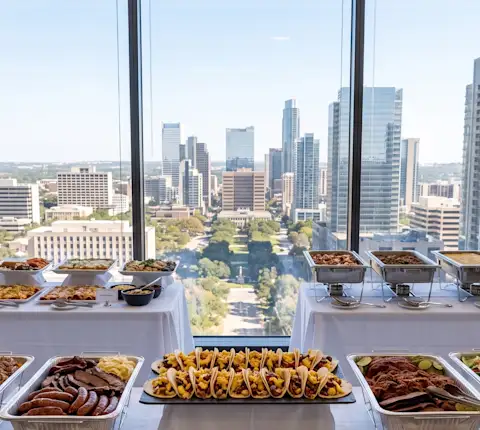
Purpose shapes format more than you'd think. A 15-person executive strategy session calls for something different from a 70-person all-hands. Not just in quantity, but in the type of experience you want to create. An intimate leadership retreat might benefit from a shared, sit-down-style meal. A large all-hands might call for a flexible buffet that people can move in and out of between sessions.
Full-day vs. half-day sessions
If your offsite runs a full day, you're feeding people across multiple touchpoints.
Morning: Breakfast or a light continental spread. Sets the tone and gets people fueled before the first session.
Mid-morning: Coffee, tea, and a small snack. Easy to overlook, but it keeps energy consistent.
Lunch: The main catering moment. This is where format, variety, and dietary coverage matter most.
Afternoon: A snack refresh, especially important for review-heavy days where mental energy is being spent faster than usual.
Half-day offsites simplify things considerably. One well-planned meal (usually lunch) and a coffee station is typically enough.
Step 2: Set a realistic catering budget
Corporate catering costs vary a lot depending on the city, the format, and what's included, but here are directional benchmarks to work from:
Working lunch (one meal, per person): $20–$35
Full-day program (breakfast + lunch + afternoon snacks, per person): $45–$65
Premium or plated-style service: $65+ per person
Note: These are estimates. Validate against your city and catering platform of choice before finalizing a budget. Costs in San Francisco and New York tend to run higher than the national average.
Hidden costs to plan for
The per-head cost is just the starting point. Also factor in:
Service or delivery fees (typically 10–20% of the order total)
Setup fees, if the catering company provides on-site service
Beverage and coffee service, if not bundled with your food order
Serving equipment (trays, chafing dishes, utensils). Confirm what the venue provides vs. what you need to source
Build a 10–15% budget buffer for last-minute headcount additions or order adjustments. It's easier to have the buffer and not need it than to scramble on the day of.
Step 3: Choose the right catering format
Not all catering setups are created equal. The right format depends on your group size, your venue, your schedule, and how much dietary complexity you're dealing with.
Format | Best for | Pros | Cons |
Tray / buffet | 20+ people | Lower per-head cost; communal feel | Needs setup space; less control over portions |
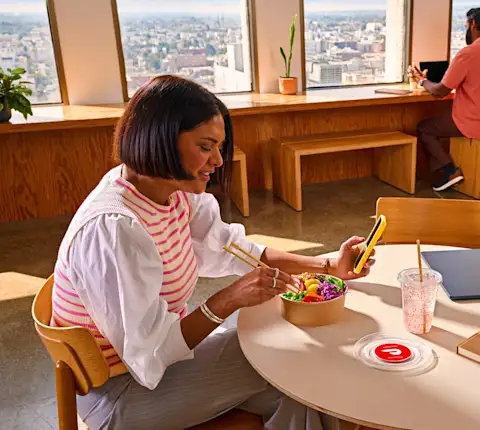
Individual boxed meals | 10–40 people | Neat, portion-controlled; easy for working sessions | Higher per-head cost; less variety visible |
Breakfast spread | Any size | Sets an energized tone; easy to graze between sessions | Needs early delivery; perishables require care |
Boxed snack packs | Any size | Perfect for afternoon sessions; low-mess | Doesn't replace a full meal |
Step 4: Build a menu that works for everyone
The most common catering complaint is that there was nothing to eat, because someone's dietary needs weren't accounted for.
For corporate events, you're almost certainly feeding a group that includes vegetarians, people with gluten sensitivities, nut allergies, and a range of other dietary needs. Plan for them upfront, not as an afterthought.
Survey your team first
Send a short dietary needs survey two to three weeks before the offsite. A simple Google Form with a few checkbox options (vegetarian, vegan, gluten-free, nut allergy, etc.) takes five minutes to create and saves you from fielding last-minute requests the morning of the event.
What you're aiming for in the final menu:
At least one clearly vegetarian option at every meal
At least one gluten-free option, labeled visibly
Nut-free options clearly identified. Critical for groups with allergy-level sensitivities
Protein variety
Lighter options alongside heartier ones, especially at lunch. For inspiration, see our office lunch catering ideas
Dietary accommodations and labeling
Ask your catering provider to include clear labels on every dish, with ingredient highlights, not just the dish name. If you're using a platform like DoorDash for Business, many restaurant partners already provide detailed item descriptions and dietary filters that make this easier to plan before the order is even placed.
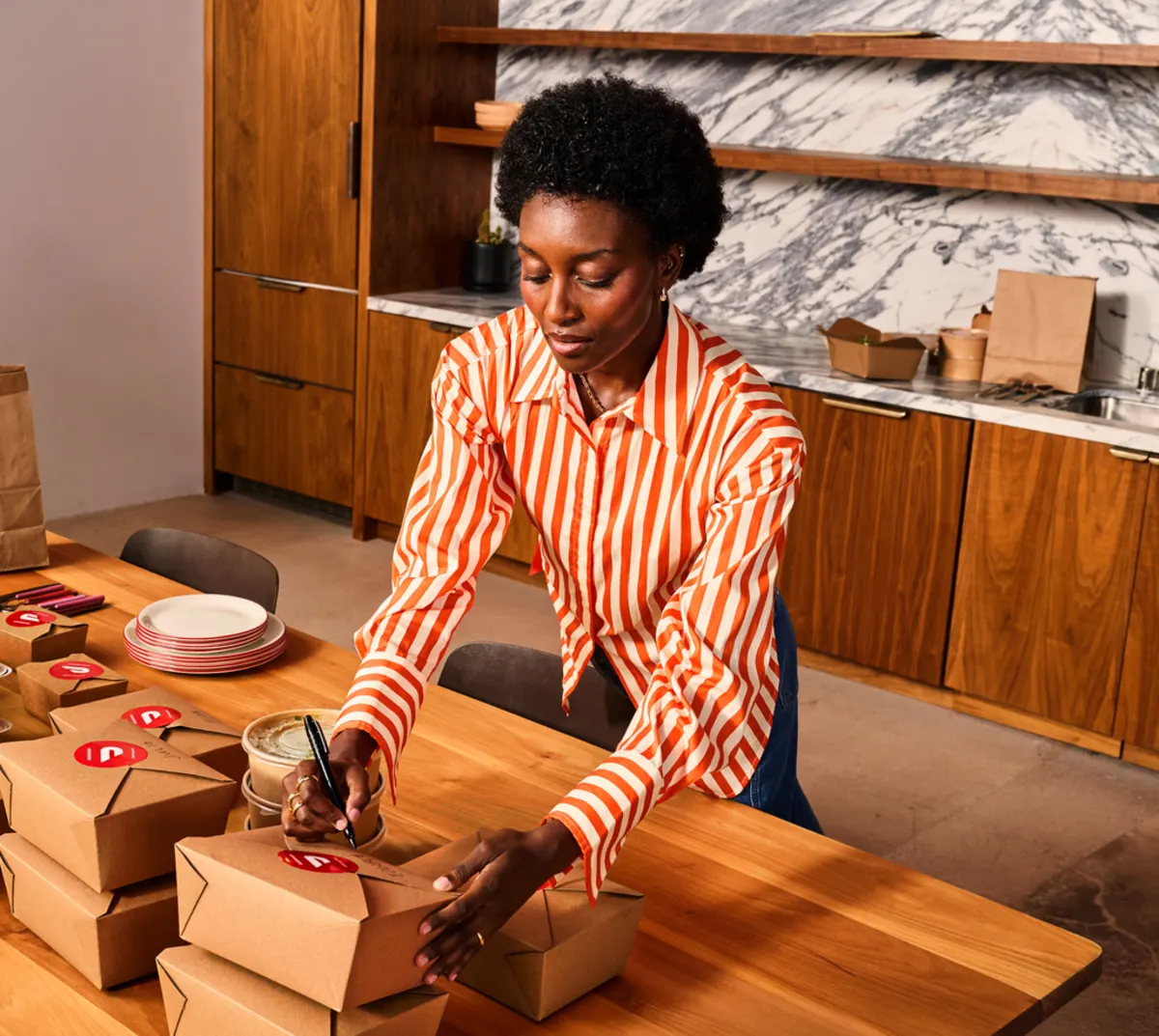
For large buffet-style setups, consider printing your own label cards.
Step 5: Nail the logistics
The best menu in the world doesn't matter if it shows up late, at the wrong address, or without anyone to receive it. Logistics is where catering for corporate events most often falls apart. It's entirely preventable with the right prep.
Lead time by group size
Under 15 people: 1–2 weeks is usually fine for most restaurant partners
15–40 people: 2–3 weeks is a safe minimum
40+ people: Book 4–6 weeks out. At this size, restaurant capacity and availability become real constraints
The further out you book, the better your restaurant selection and the lower your risk of a last-minute scramble.
For more on timing and what to confirm before you place the order, our catering tips for office events article covers the finer points.
Day-of logistics
Even the most carefully planned orders can go sideways if no one is managing the day-of details. Before your offsite, confirm:
Delivery window: Request arrival 30 minutes before your first food moment, or earlier if the setup is complex
On-site contact: Designate one person to receive the delivery and direct setup
Venue access: Share parking instructions, loading dock access, elevator details, and any building entry requirements with your catering contact
Order confirmation: Print or screenshot your order confirmation to have on hand if anything needs to be reconciled
Ready to simplify the logistics? See DoorDash for Business Catering →
Step 6: Don't forget the details
The big pieces, format, menu, and logistics, get most of the attention. But the small details are often what people actually remember.
Coffee and beverages
Underestimating beverage needs is one of the most common offsite catering mistakes. A full-day offsite should have coffee and tea available from the start of the morning through at least mid-afternoon. If you're relying on a single coffee station to carry a room of 40 people through six hours of sessions, you're going to run short.
For larger offsites, consider a separate coffee and beverage order distinct from the food. Water, sparkling options, and juice at breakfast round things out without adding much complexity. If you're planning the morning spread from scratch, our office breakfast catering guide is a good starting point.
The afternoon snack moment
Plan for it. Explicitly. Especially on days with dense agendas: performance reviews, strategy sessions, quarterly planning. The 3 p.m. energy dip is real, and a snack refresh does more for room engagement than most facilitators would admit.
This doesn't need to be elaborate. Fruit, individually wrapped snacks, or a small pastry refresh from the morning does the job. Stage it separately from the lunch setup so it's easy to access without disrupting the flow of the session.
Equipment, utensils, and cleanup
Confirm with your venue and catering provider who is responsible for:
Serving trays, tongs, and serving utensils
Plates, napkins, and cutlery
Trash and recycling access during and after the event
End-of-event cleanup, especially if the venue has restrictions on food waste or packaging
Leaving these details unconfirmed until the day of is the fastest way to end up improvising. A quick checklist conversation with the venue a week out covers it.
How DoorDash for Business simplifies corporate offsite catering
Coordinating catering for a corporate offsite usually means multiple vendor calls, unclear reliability, and a lot of manual follow-up. DoorDash for Business Catering is built to remove most of that friction.
On-time guarantee: 100% of orders arrive on time, or you get your money back. For a day with a fixed agenda, reliability matters.
Catering-ready restaurant partners: Restaurants with catering menus include clear serving sizes, package options, and dietary filters so you can plan accurately before placing the order.
Works with or without a DDfB account: No DDfB account is required to place a catering order. Anyone can order directly at doordash.com.
Live order tracking: Track your delivery in real time in the app, so you're not refreshing a confirmation email and hoping for the best.
No new vendor contracts: Everything runs through the DoorDash app, without having to go through lengthy onboarding or vendor agreements.
Corporate offsite catering checklist
Print this out, save it to your desktop, or bookmark it for the next time an offsite lands on your calendar.
PHASE | WHAT TO DO |
6 weeks out | ☐ Lock in your offsite venue and confirm the setup space for food service ☐ Send a quick dietary needs survey to all attendees (a simple Google Form works) ☐ Book catering. At this lead time you'll have the best restaurant selection ☐ Set your per-head budget and build in a 10–15% buffer |
2–3 weeks out | ☐ Confirm final (or best-estimate) headcount with your catering order ☐ Review dietary responses and adjust the menu accordingly ☐ Get the venue floor plan so you know exactly where food will be set up ☐ Confirm any equipment the venue will or won't provide (serving trays, utensils, etc.) |
1 week out | ☐ Reconfirm your delivery window and expected arrival time ☐ Share venue address, parking instructions, and point-of-contact details with your catering contact ☐ Order coffee and beverage service if not already included |
Day before | ☐ Confirm your order is locked and any last-minute headcount changes are in ☐ Remind your on-site point person of their role (greet delivery, direct setup) ☐ Prepare your setup area. Clear the space and know where everything goes |
Day of | ☐ Allow a 30-minute buffer before your first session for food setup ☐ Have your on-site contact ready to receive and direct the delivery ☐ Stage afternoon snacks and coffee separately so they're easy to refresh ☐ Keep a printed copy of your order confirmation in case of any discrepancies |
Make the food the easy part
An offsite is only as good as the experience you create, and the experience starts before anyone opens a laptop. Food sets the tone. It signals that the day was planned with care. And when it runs smoothly, it frees everyone up to focus on the work that actually matters.
DoorDash for Business takes the coordination off your plate so you can put your energy where it belongs. Explore all DoorDash for Business meal solutions, from catering for corporate events to Group Orders and Vouchers for remote and hybrid teams.