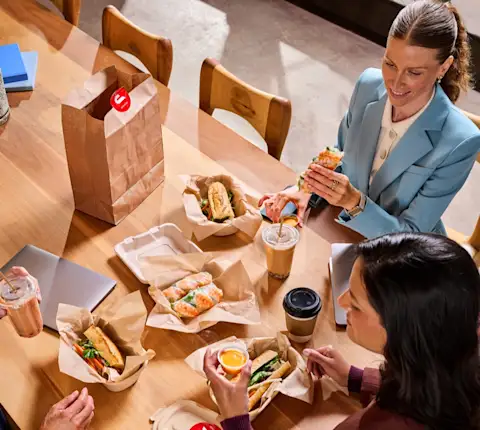
Salads, rice bowls, and sandwiches dominate what employees order at work in 2026, but the more interesting story is in when they order them and how that's shifted. Data from the 2026 DoorDash Workplace Delivery Trends Report — pulled from real orders across 767 companies and 4,871 offices — shows that what people eat at work follows a surprisingly consistent arc across the week, across industries, and across cities. And for anyone managing a meal program, that arc matters even more than the menu.

What employees eat at work in 2026 (and why it keeps shifting through the week)
The staples haven't changed much. Salads, rice bowls, and sandwiches still account for the bulk of workplace orders. What has changed is the pattern around them.
Healthy meal orders are 30% higher on Tuesdays than on Fridays. The person who chose a grain bowl and sparkling water at noon on Tuesday is, by Thursday afternoon, ordering pasta and a second coffee. By Friday, comfort food is up across the board, and caffeine orders peak.
This tracks almost exactly with how cognitive load compounds over four days. Early in the week, people have bandwidth to make intentional choices. By the end of the week, decision fatigue sets in and the easiest option wins — usually something warm and filling.
A program built around a single nutrition profile, like all greens at all times, tends to see engagement drop midweek, right when people need support most. And the fix isn't necessarily a better menu.
Employees who order through a meal program multiple times a week are 54% more likely to choose the healthier option. Consistency does more for wellness goals than curation alone, and a workplace food program that aligns with the weekly rhythm performs better than one that doesn't account for it.
The bigger takeaway here is that food choices at work reflect workload, not just preference. What's trending in workplace food in 2026 isn't a specific cuisine. What your team orders is a signal that’s worth learning to read.
Thursday is the new Friday for office lunches
If you're trying to figure out which days to anchor your in-office meal program, the data makes a strong case for midweek, specifically Thursday.
Workplace orders peak on Thursdays, with 20% more orders than Mondays. Large group orders have grown 30% faster year-over-year than regular orders, and they cluster on Tuesday through Thursday. The office isn't back in a 9-to-5, five-days-a-week way. It has returned in a concentrated, intentional, midweek way around collaboration, planning sessions, and the kind of work that's better done in a room together.
The monthly pattern is just as telling. Large group orders see the strongest year-over-year growth in March (up 33%), September (up 30%), and December (up 34%). Those are planning-heavy months: Q1 kickoffs, back-from-summer regrouping, and year-end pushes. Teams work together in the office, and food helps structure their day.

So, what does this mean for your food program? A Monday-only meal benefit, or a program that doesn't account for the Thursday spike, is going to feel misaligned pretty quickly. Anchoring group orders around Tuesday through Thursday — and planning ahead for March, September, and December — puts the food where the people actually are.
High-pressure industries eat differently at work (and spend more)
The averages tell one story. The industry breakdown tells another.
AI companies have essentially inverted the traditional office meal pattern. While most workplaces see peak orders at noon, AI companies see their busiest delivery window between 5 and 7 p.m. That reflects how high-pressure teams work: long days, late focus hours, and a workday that doesn't wind down when most offices do.
Spend follows the same logic. Consulting firms have the highest average order spend across all industries tracked. AI companies spend about $6 more per order than the cross-industry average. When the workday regularly runs past 7 p.m., a meal benefit becomes part of how the work gets done.

The geographic picture adds another layer. Late-night workplace orders are heavily concentrated in a handful of cities: the Bay Area accounts for 24% of them, Manhattan 23%, Chicago 20%, and Austin 20%. If your team is in one of these markets and working in a fast-moving industry, the after-hours meal question is already happening.
Pharma and consulting also dominate weekend workplace orders, which points to sustained workloads that don't stop at Friday. For People leaders in those sectors, a meal program that only covers Monday through Friday lunches is covering maybe 60% of
the actual use case.
What these food trends mean for how you design a meal program for your office
Order data is only useful if it changes something. Here's what these patterns actually suggest for program design.
If your team is in the office midweek, that's when your meal program needs to perform. Group orders scheduled for Tuesday through Thursday will see higher participation than Monday or Friday, and the investment in those days is more likely to anchor the behavior you're trying to support (in-office collaboration, team culture, retention of RTO habits).
If wellness is part of your program's goal, Tuesday and Wednesday are your window. That's when the program earns its keep on nutrition, so lean into it. By Thursday, give people something more satisfying. Fighting end-of-w
eek fatigue with a salad menu is a losing battle.
If you're in AI, consulting, pharma, or any other industry where work regularly spills past 6 p.m., build that into the program. Credits for meals with time-of-day rules give you a way to cover those hours without opening up the entire budget.
A few practical anchors worth building into your work food calendar: March, September, and December are when large group orders spike, which tracks with planning-heavy moments in the business year. Those are good months to schedule your biggest team meals, since your team is already in the office with work to do together. The food is what gives those days a reason to show up for.
The data behind these workplace food trends
The patterns in this article come from the 2026 DoorDash Workplace Delivery Trends Report, which analyzes real order data from 767 companies across 4,871 offices. The industries covered include AI, banking, pharma and healthcare, consulting and accounting, and tech.

Unlike survey-based workplace trend reports, this data reflects actual ordering behavior — what employees chose to order, when they ordered it, and how that's changed year-over-year.
You can download the full report here for a deeper look at the industry and city-level breakdowns, including more detail on after-hours patterns, seasonal spikes, and spend by sector.
Ready to build a program around how your company actually works? Talk to us to explore options for group orders, recurring meal programs, and food credits for your team.