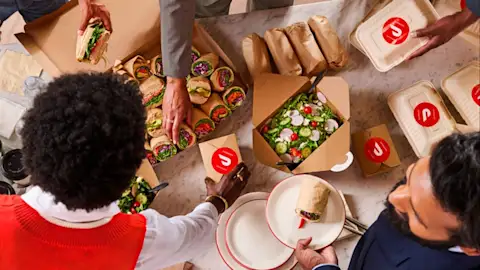
What is a group lunch program?
A group lunch program is a structured way to provide recurring, company-supported meals to employees across locations and work styles. It typically combines in-office group orders and catering, flexible meal benefits like credits and vouchers, and centralized tools for budgets, policies, and reporting.
When done well, it turns everyday meals into a visible employee meal benefit that helps employees feel appreciated, reduces logistical friction, and gives HR and finance better visibility into food spend. For HR and people leaders, lunch becomes a practical lever for engagement and culture — not just a perk.
Why should companies invest in employee meal benefits?
Employee meal benefits can support multiple priorities at once, from morale to hybrid work to budget discipline. A thoughtful group lunch program helps organizations move beyond ad hoc ordering to something reliable and measurable.
Key reasons HR and people leaders are investing:
Improve engagement and retention by giving employees a tangible sign of appreciation and more opportunities to connect in person.
Give time back to employees who might otherwise spend an hour or more each week planning, prepping, or grabbing food.
Strengthen hybrid work by tying meals to in-office “anchor days” so the commute feels worthwhile and collaboration-heavy days feel more rewarding.
Prove value to finance and leadership with centralized tools that track food spend, usage, and satisfaction across teams and locations.
Chapter 1. Design a group lunch plan that works across locations
The strongest group lunch programs offer a mix of options that match how and where employees work. This kind of flexibility helps keep things fair for in-office, hybrid, remote, and field teams, so no one feels left out of the experience.
With so many program options to choose from, it helps to start by mapping options to specific use cases to your organization itself.
Meal credits provide recurring or one-time stipends managed through DoorDash for Business’ centralized admin portal, with business profiles and built-in expense integrations so eligible receipts can flow automatically into tools like SAP Concur, Expensify, or Emburse. For employees that are regularly traveling, this can reduce manual expense and lost receipt headaches.
Hybrid and remote employees need flexible meal benefits
Expensed Meal Credits give them recurring budgets they can use for desk lunches, late nights, or travel days, while HR controls when, where, and how much employees can spend.
Deskless staff, field teams, and frequent travelers
Often have tight schedules and changing locations, so a flexible meal setup helps them get reliable food delivery.
DashPass lets employees quickly find meals near job sites or hotels, while the company stretches its budget with $0 delivery charges and reduced service fees. Employees also tend to adopt it quickly because the experience is similar to placing a personal DoorDash order, which feels familiar and easy to navigate.
For in-office days and hub locations
Group Orders provide recurring or one-time stipends managed through DoorDash for Business’ centralized admin portal, with business profiles and built-in expense integrations so eligible receipts can flow automatically into tools like SAP Concur, Expensify, or Emburse. For employees that are regularly traveling, this can reduce manual expense and lost receipt headaches.
For one-time events like virtual town halls, offsites, or trainings
Vouchers provide single-use links employees and guests can redeem within a set budget and time window, and companies only pay for vouchers that are actually used, which helps keep costs predictable.

Chapter 2. Start with consistency, not complexity
Great group lunch programs do not have to start big — the key is building a repeatable framework. A consistent cadence and clear expectations help employees participate and help admins plan.
Set a lunch cadence
To keep participation high without overwhelming budgets. For example, monthly or quarterly catered lunches can anchor town halls, monthly meetings or key milestones. Weekly lunches can also help reinforce employee engagement and keep productivity levels high.
Use a recurring meal calendar
Give employees something to look forward to and schedule group orders in advance. A visible calendar also helps avoid overlap with other events or peak workloads. Automated reminders and recurring orders can remove a lot of manual coordination.
Centralize and simplify ordering logistics
Manual ordering across multiple restaurants or spreadsheets creates friction for admins and confusion for employees. A group order system centralizes the experience so people can add their own meals while the company manages a single delivery.
With DoorDash Group Orders, admins can:
Let employees choose what they want while consolidating everything into one delivery to the office.
Set delivery windows and order cutoffs up to two weeks in advance to avoid last-minute chaos.
Pay from a central budget, or let individuals apply meal credits or personal cards if they go over.
This structure reduces time spent reconciling receipts, chasing down orders, and answering “Did my order go through?” while still giving employees control over what they eat.
Ensure predictable spending for the CFO
Budgeting is the backbone of a sustainable group lunch plan. Shifting from ad hoc reimbursements to structured meal credits and clear per-person caps makes it easier to stay on budget and report back to finance.
Per-person or per-team budgets
DoorDash allows you to set consistent per-person caps across locations, adjusting for cost of living where needed. For events, define a per-head budget that still offers enough menu variety.
Eligibility and ordering windows
Decide who receives recurring meal credits (for example, by role, level, or team) and when they can use them. Set ordering windows — such as weekdays, 10 a.m. to 3 p.m. — and restrict categories such as alcohol.
Keep delivery and service fees predictable, not a surprise line item
DashPass memberships save roughly $5 per employee order on average. When combined with built-in spend limits, this helps programs scale without company overspending.
Keep policies simple and enforceable
A successful employee meal program has to work for both employees and administrators. It needs to create a smooth, positive experience for employees while giving HR, finance, and procurement confidence that policies are clear, consistent, and actually followed.
Employees value clarity, and admins need guardrails that do not rely on manual policing. Launch your program with simple instructions, clear documentation, and frequent reminders so everyone understands who is eligible, how to order, and what the guidelines are.
Keep the program fair and predictable across teams and regions with centralized controls.
Build in program controls such as requiring expense codes or notes at checkout to ensure compliance and cut down on HR admin work.
Enforce spend limits and category rules automatically, instead of relying on manual reviews and audits after the fact
Reduce admin overhead with a repeatable playbook
Office admins and workplace managers often handle the day-to-day work of group lunch programs. This clear playbook helps them support more teams without adding stress to their workload.
STEP 1
Streamline how employees order
Skip the back-and-forth emails and spreadsheets.
Set up a Group Order once, share the link in Slack or email, and let employees add their meals before the deadline.


STEP 2
Use onboarding to get it right once
Work with our dedicated onboarding specialists to set your policies once — things like daily budgets, eligible restaurants, and recurring meeting orders — so you are not reinventing the process every time a new team wants lunch
Ongoing support by phone, chat, or email, plus proactive monitoring for large orders.
STEP 3
Rely on business support instead of doing it all yourself
Instead of monitoring every large order yourself, tap into business support that tracks high-value deliveries and helps resolve issues quickly — so you can stay focused on your day-to-day work, not the status of every sandwich.


STEP 4
Offload onsite logistics for large offices
In large offices, lunch can take over your entire afternoon.
Waiting in the lobby, sorting bags, and answering “Which one is mine?”
Onsite support can receive, stage, and organize orders for you, so lunches are ready where and when employees need them.
STEP 5
Turn one process into a repeatable playbook
Build a single lunch program that works across teams and locations. Then copy it for new offices and events, instead of starting from scratch for every ask!

Chapter 3. Creating a great employee experience
A well-run group lunch program feels simple and inclusive from the employee’s perspective — even if the backend is complex. From onboarding to everyday ordering, the experience should be clear, flexible, and fair.
3 key areas to focus attention on:
Employee onboarding
A new hire receives a welcome email with an “Activate your meal benefit” link and can start using their work profile without extra logins or reimbursement forms. Build strong rapport in their first week!
Flexible meal ordering
For a monthly all-hands, employees see one Group Order link with a clear budget and cutoff time, then grab a bag labeled with their name when lunch arrives. Even long meetings feel more manageable when there is a reliable, good meal to look forward to.
Inclusive lunch choices
Employees browsing the DoorDash app see big-name chains and neighborhood favorites, with options for halal, vegan, vegetarian, and gluten-free diets in the same program. This kind of experience reinforces the message that the company values both convenience and inclusion.
Balancing variety with reliability
Employees appreciate choice, but admins value consistency. Using a broad marketplace (DoorDash features 500,000+ restaurants nationwide) ensures variety while maintaining predictable delivery standards.
3 ways to keep meals fresh and reliable:
Alternate cuisines or themes each week, such as “Taco Tuesday” or “Mediterranean Monday.”
Work in dietary-friendly favorites that cover vegan, gluten-free, and halal preferences.
For special events, use catering options with boxed meals to simplify setup and cleanup.
Keep it engaging throughout the year
The best meal programs evolve with your culture. Encourage employees to:
Vote on restaurants or menus quarterly.
Celebrate milestones with special group lunches or seasonal treats.
Rally teams regularly through lunch and learn.
Rotate “lunch leads” to keep engagement fresh and not burdensome to one individual
Chapter 4: How do you communicate and roll out an employee meal program?
STEP 1
Lead with the “why”
Link the program to your broader employee meal benefits strategy and hybrid work plan. Emphasize appreciation, connection, and focus — not just free food.
DoorDash for Business teams can partner with you to craft launch messaging and email copy that fits your culture and speaks directly to your employees’ needs.


STEP 2
Make it easy to understand
Use simple, company-wide announcements with clear eligibility rules. Provide short how-tos or GIFs showing how to join group orders and redeem credits or vouchers.
DoorDash partners can also help you customize messages for digital signage, intranet banners, or office TVs, including QR codes that make it easy for employees to get started right from their phones.
STEP 3
Equip people managers
Share talking points so managers can answer common questions. Encourage them to tie lunches to team rituals, such as retros, project kickoffs, or all-hands.
Our account teams can share proven ideas and best practices managers can use to keep participation high and bring the program to life on their teams.

Chapter 5: Using data to measure and improve food programs at work
The best group lunch programs evolve with employee feedback and clear metrics. Data helps HR, finance, and leadership see how food benefits contribute to engagement, retention, and office attendance.
With DoorDash’s Insights Dashboard, admins can:
Track quantitative metrics such as participation rates, average spend per person or event, and usage of meal credits and vouchers.
Listen to employees via short pulse surveys and open feedback channels focused on satisfaction, dietary needs, restaurant suggestions, and cadence.
Iterate over time by adjusting budgets, cadence, restaurant selection, and formats based on what the data and feedback show.
These insights make it easier to tie program metrics to broader outcomes like engagement scores, eNPS, retention on critical teams, and in-office attendance.
How DoorDash for Business supports your program
DoorDash for Business offers tools that map directly to the main use cases of a group lunch program, helping teams standardize one approach across offices and work styles. The table below consolidates both drafts into a single, easy reference.
Use case | Feature | How it helps |
Weekly in-office team lunches | Group Orders | Employees add their meals to a shared cart; admins set budget and schedule. |
Large all-hands or client meetings | Catering | Pre-vetted restaurants, clear serving sizes, trays or boxed meals for 15+. |
Hybrid teams with recurring meal benefits | Expensed Meal Credits | Recurring budgets employees can use anywhere, with HR-controlled rules. |
One-time virtual events or offsites | Vouchers | One-time links for employees and guests; companies pay only for redemptions. |
Boosting the value of meal credits | DashPass | $0 delivery and reduced service fees on eligible orders to stretch budgets. |
Managing budgets and compliance at scale | Admin Portal & Insights Dashboard | Centralized controls, spend visibility, and reporting by team and location. |
Reducing manual expensing and receipt chase | Business Profiles & Integrations | Automatically route receipts to tools like SAP Concur, Expensify, Emburse. |
Handling high-volume office logistics | Dedicated & Onsite Support | White-glove onboarding, monitored large orders, and optional onsite help. |
Fuel teamwork with smarter group lunch ordering
A reliable lunch program doesn’t just feed employees — it fuels culture, connection, and productivity. With DoorDash for Business, admins can design flexible, compliant, and cost-effective meal plans that run themselves.
Plan your first recurring group lunch today