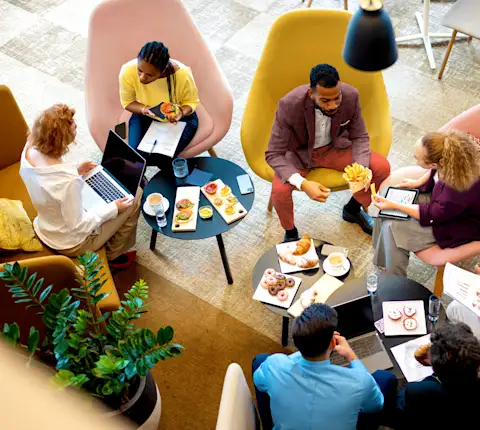
New Year’s resolutions at work don’t necessarily have to mean cramming more tasks into your every day; they can be as simple as making time to actually eat lunch and take real breaks again. When teams step away to refuel, they tend to come back more focused, more creative, and less burned out.
The problem with skipping lunch
Across industries, many employees are working straight through the middle of the day, often because they feel too busy or worry they will be judged for stepping away. Surveys in recent years have found that many workers skip lunch at least once a week, and a large share regularly eat lunch at their desks rather than taking a true break. Even when lunch is blocked on the calendar, that time often gets taken over by meetings or urgent tasks instead of being used to recharge.
The intent behind working through lunch is usually good: finish more work, stay responsive, make the most of the schedule. But research points in the opposite direction — employees who take regular lunch breaks report higher productivity, engagement, and job satisfaction than employees who rarely step away. Studies on work breaks also connect skipping them with higher stress, emotional exhaustion, and a greater risk of burnout over time.
Resetting: a real lunch break most days
One of the most powerful work resolutions is also one of the most realistic: committing to a real lunch break most days, even if it is shorter than the ideal hour. The exact timing and length will vary by role, location, and shift, but the goal is the same — spend at least part of the midday meal away from active work so the brain has a chance to reset.
Leaders and admins can help by turning “nice to have” into “expected.” Teams can encourage people to put a recurring lunch block on their calendars and treat it as default protected time, not just optional white space. They can also set expectations that internal meetings are not scheduled over lunch unless there is truly no alternative, which helps reduce the social pressure many employees feel to be “always on.” When companies make it clear that lunch is part of the workday, not a sign of slacking, employees are more likely to actually use that time. Employees are more likely to take a lunch break when companies emphasize that this time is a part of the workday, not an indication of low productivity.
For organizations that already invest in workplace meals, there is an opportunity to connect the dots explicitly. Rather than positioning food benefits purely as a perk, companies can frame them as a way to make it easier for employees to step away and enjoy a real break, whether that means simple in-office options or flexible meal programs that work for hybrid teams.
Why breaks boost performance
A growing body of evidence shows that taking regular breaks from mental tasks improves productivity and creativity, while skipping breaks can lead to stress and exhaustion. Reviews of work-break research link pauses during the day to better wellbeing and, in many cases, improved performance — especially when breaks are long enough and used intentionally rather than squeezed in while multitasking.
The benefits do not require dramatic changes. Short pauses give cognitive resources a chance to recharge, which supports sustained attention and better decision-making in the afternoon. Employees who take lunch away from their desks often report returning with a fresh perspective on problems they were stuck on, which can lead to more creative solutions and fewer mistakes. When managers view breaks as an instrument for enhancing performance (instead of seeing them as a diversion), it simplifies the process of establishing supportive team norms that are more reliable than individual willpower.
Micro-resolutions for busy days
Not every day will allow for a perfectly timed, device-free lunch, so it can help to create smaller “micro-resolutions” around breaks that are easier to keep. Even five- to ten-minute pauses have been linked to reduced fatigue and better mental health, especially in demanding or screen-heavy roles. These micro-resolutions can include simple actions such as standing up between long virtual meetings, taking a brief walk down the hall, or doing a quick stretch before diving into the next task.
Hydration and movement can be part of this reset as well. Many workers report forgetting to drink water during intense focus periods, which can contribute to headaches and mid-afternoon sluggishness. Setting gentle reminders to refill a water bottle, pairing a quick walk with a snack, or using a recurring calendar nudge for an afternoon stretch can make it easier to protect energy without feeling like yet another item on the to-do list. In environments where teams already have access to workplace food or snack programs, anchoring microbreaks to those moments can create a simple, built-in rhythm for stepping away.
Lunch as a social and cultural reset
Food breaks are not only about nutrition; they are also a natural moment for social connection and culture-building. Many office workers report eating lunch alone at their desks at least half the time, which means they may be missing out on informal conversations and relationships that make work feel more supportive and human. The New Year is a useful moment to rethink how teams use that midday window to connect, especially as organizations balance in-office, hybrid, and remote work.Teams can create gentle, opt-in resolutions around connection instead of forcing constant socializing:
Once-a-week “lunch with someone new” intentions
Topic-based lunch clubs
Occasional “no-desk lunch days”
Flexible timed lunches where people can order what they like and join an optional video room or chat (for hybrid or distributed teams)
Thoughtful meal programs can amplify these efforts. When companies make it simple to coordinate team lunches, whether through recurring group orders or budgeted meal programs, they are not just feeding people; they are signaling that taking time to eat together and reset is a valued part of the workday. The logistics matter here: when food arrives reliably and on time, employees can spend less energy worrying about where to eat and more time actually enjoying the break.
Quick checklist: helping employees actually adopt break habits
Resolutions tend to fade without systems to support them. These simple, practical steps can help HR, People teams, and managers turn break-focused goals into everyday behavior.
Clarify the “why” and the goal
Connect breaks to outcomes leaders care about.
Sustainable performance, reduced burnout, and better engagement.
Define what success looks like (for example: get most employees to eat a lunch away from their desks several times a week).
Set simple, flexible norms
Share short guidelines that normalize lunch and microbreaks, and discourage booking internal meetings over core lunch hours where possible.
Keep language clear, approachable, and tailored to different teams and time zones.
Equip managers to model the behavior
Give managers talking points for team meetings and encourage them to block their own lunch, decline non-urgent lunch-time meetings, and occasionally mention when they are stepping away.
When managers take breaks, employees are more likely to feel permission to do the same.
Use light reminders instead of one-off campaigns
Offer calendar templates for “protected lunch,” share sample away messages that make it feel normal to step away, and send occasional, friendly nudges in collaboration tools.
Brief, consistent reminders tend to work better than a single all-hands announcement.
Make breaks easy, not extra work
Look for ways to reduce friction, such as ensuring there are inviting spaces to eat, aligning shared breaks with existing rituals, or using workplace food programs so employees are not spending their entire lunch period figuring out what to eat.
When refueling is simple and predictable, stepping away feels less costly.
Listen, iterate, and keep it visible
Use quick pulse surveys or manager feedback to understand what gets in the way of breaks, and adjust norms as workloads or hybrid patterns change.
Reinforce positive habits by sharing wins with teams, such as increased use of the designated lunch time or reports of improved afternoon energy.
A new kind of New Year’s resolution
Traditional New Year’s resolutions often focus on squeezing more out of every hour — more tasks completed, more meetings, more late nights. The science on breaks points toward a different approach: creating space to recover during the day so employees can show up with sustained focus and energy, not just willpower.
For employees, a realistic resolution might be as simple as this: most days, eat lunch away from the keyboard and take at least one short, intentional break in the afternoon.
For leaders and admins, the companion resolution is to design schedules, spaces, and supports that make those habits feel natural. From meeting norms to meal programs that make it easier to step away, so nobody feels guilty for taking a moment to recharge.