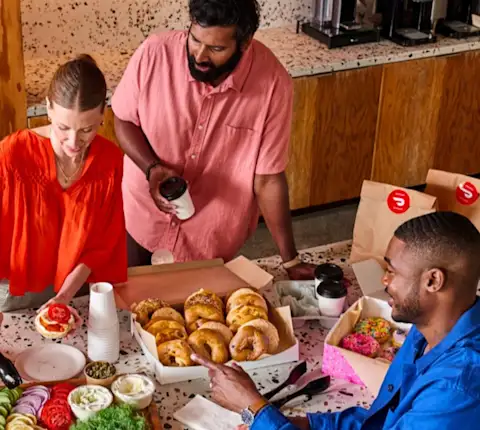
Some of the best moments at work are the ones where somebody notices: a project that went long and landed well, a colleague who covered for a teammate without being asked, a work anniversary that would have slipped past unmarked. Those moments deserve more than a message in a group channel, and a corporate gift card is one of the easiest ways to turn a simple thank you into a meaningful gesture.
The right gift card should work across different locations, tastes, and dietary preferences. A food delivery gift card offers that flexibility by allowing each employee to choose from eligible restaurants and stores available near them.
Gift cards are one of the simplest ways to show appreciation
Recognition works best when it’s specific and when it arrives quickly. A gift card does both without much effort on your part. You can send one the same afternoon somebody did something worth noticing, and it carries a weight that a Slack emoji reaction doesn’t.
The other thing a gift card does well is give the recipient the last word. A physical gift asks the giver to guess right about somebody else’s taste, and the guess is often wrong in ways nobody mentions out loud. A gift card hands that decision back, so the employee gets something they chose while the recognition still clearly came from you.
In this Incentive Research Foundation’s study of 1,500 US employees, gift cards for food or merchandise were the only tangible reward to reach the top tier of recognition preferences, and 38% named a food gift among the forms of recognition they’d most like to receive.
It also scales in a way that most other forms of recognition don’t. The same gesture works for a team of eight and a company of eight hundred, and it works for someone in the office on Tuesday and someone three time zones away. That flexibility is what makes gift cards a practical answer for employee recognition rather than just a thoughtful one.
Why food is the category employees put to use
Where gift cards tend to fall apart is in the choice of category, and food is the category that fails least. Eating isn’t optional, so a food card doesn’t ask the recipient to want anything unusual. It asks them to do something they were already going to do this week, and that makes the difference between a card that gets used on Thursday and one that sits in an inbox until it’s forgotten.
It’s also the rare gesture that carries meaning beyond the dollar amount: a meal is a small break in a workday, and giving somebody one reads as consideration rather than compensation. If you’re building recognition into a broader rewards and gifting strategy focused on employee rewards, food is usually the piece that people remember.
How digital and virtual food gift cards work
The mechanics of digital gift cards for employees vary by issuer, so the details are worth checking before you commit to one. What follows is how DoorDash corporate gift cards work, which also gives you a sense of what to look for elsewhere.
Delivery is where the real advantage sits. Virtual gift cards for employees go out by email, and through the bulk portal they arrive within a business day of payment processing, or on a date you schedule up to a year ahead. For a distributed team that’s the difference between a manageable process and a logistics project, since you’re not collecting home addresses or chasing envelopes that went to somebody’s old apartment. If you’re running recognition across remote and hybrid teams, digital delivery is what makes the whole thing workable.
Physical cards still exist if you want something tangible, ordered in batches of 25 or more through DoorDash’s bulk portal. They ship inactive and have to be activated once they arrive, which is a step that gets missed often enough to be worth writing into your own internal checklist.
A few practical things about e gift cards for employees that are worth knowing before you buy:
Denominations usually run from $15 to $500, so you’re not locked into preset tiers
DoorDash gift cards don’t expire, which takes away the pressure to redeem by a deadline
Redeeming requires the recipient to have an account on the platform. Setting one up takes a few minutes, but it’s a real step, and it’s better to mention it in your message than to let people run into it unexpectedly
When broader choice may be useful
A gift card tied to a single restaurant may not work for every employee, particularly when location, dietary needs, and personal preferences vary:
Location: restaurant chains look ubiquitous from a headquarters perspective, but coverage thins out quickly outside major metros, and an employee facing a twenty-five minute drive to spend $30 generally won’t bother.
Cuisine: buyers underestimate it more than the others. Picking a restaurant means picking a cuisine on someone else’s behalf, and there’s no version of that guess that holds up across an entire team.
Dietary needs: allergies, medical restrictions, religious practice, and plain preference are all things you can’t reasonably survey before sending a gift, and all things that can turn a single-restaurant card from merely unappealing into genuinely unusable.
A card covering a wide range of restaurants doesn’t solve the guessing problem so much as it removes you from having to guess at all. Everybody on the list gets to pick their own dinner, which is why breadth of coverage does more for a gesture like this than picking the right restaurant ever could.
Buying and sending at volume
Sending a handful of cards is easy. Sending three hundred before the end of the quarter is a different exercise, and it helps to know how the process works before you’re in it.
Bulk ordering in DoorDash starts at a 25-card minimum for physical orders, eGift cards have a $1,000 order minimum and runs through a dedicated portal. If you’re looking to spend less than $1,000, individual purchases are available through the Gift Cards page.
Two things are worth building into your process from the start.
Scheduling ahead is the first, since the portal accepts delivery dates up to a year out, which means birthdays, Christmas, and work anniversaries can be loaded once and then left alone rather than tracked by hand every month.
The second is keeping an eye on how many cards actually get used, not just how many you bought. Those two numbers diverge more than most teams expect, and the gap is the clearest signal of whether your gesture is landing and driving real employee engagement.
It’s also worth thinking about the message that goes with the card. A line explaining what the card is for takes a few seconds to write and is the difference between a gift that feels considered and a notification that looks like a system email.
Make it easy for people to feel appreciated
Recognition doesn’t have to be complicated to work. Most of the time it just has to be timely, specific, and easy for the person receiving it to enjoy without any extra effort on their part. A meal on you clears all three, which is why it keeps working long after the novelty of other perks has worn off. When you’re ready to send some, you can order gift cards for employees one at a time or in bulk and have them land in an inbox the same week.
Frequently Asked Questions
Are employee gift cards taxable?
Generally the IRS treats gift cards differently from other in-kind benefits, since they function as a cash equivalent rather than a small non-cash perk. It’s worth building that into your budget rather than treating the face value as the total cost. IRS Publication 15-B covers fringe benefit treatment, and your finance or tax team is the right place to confirm how it applies to your specific program.
Can you use restaurant gift cards on DoorDash?
No. A gift card issued by an individual restaurant can only be redeemed with that restaurant, either in person or through its own channels, and it won’t work as payment on a delivery platform. The reverse holds as well, so a platform gift card is used at checkout on the platform rather than at a restaurant counter.
Do DoorDash food gift cards expire?
It varies by issuer, so it’s worth checking before you buy in volume. DoorDash gift cards don’t expire and don’t deduct fees, which matters more than it sounds when you’re sending several hundred at once and can’t control when each person gets around to using theirs.
What gift cards work best for corporate gifting?
Cards that work almost anywhere give the widest flexibility but tend to read as cash, single-retailer cards feel considered but only work if you guessed right, and cards tied to a category the recipient uses regularly give choice without losing the sense of a gift. Food sits in that last group, which is what makes it hold up across a whole team, since everyone eats and nobody needs to want anything unusual to put the card to use. A DoorDash gift card works across restaurants, grocery, and convenience, so the recipient chooses the occasion rather than being handed one.
Are gift cards a good reward for employees?
For recognition tied to a specific moment, like a milestone or a piece of work that went well, they’re a strong fit and they land quickly. For something recurring, like a standing meal benefit or a program with rules about when and where it applies, Meal Manager or Meal Budget handle the administrative side better and give you more control over spend. Plenty of companies run both, using gift cards for the moments and a budget for the routine.